Tuesday, April 5, 2016

Keeping the Faith in a Time of Terror

Keeping the Faith in a Time of Terror

03/25/2016 02:19 pm ET | Updated Mar 25, 2016
  • Jim Friedrich Episcopal priest, liturgical creative, filmmaker, musician, teacher and writer
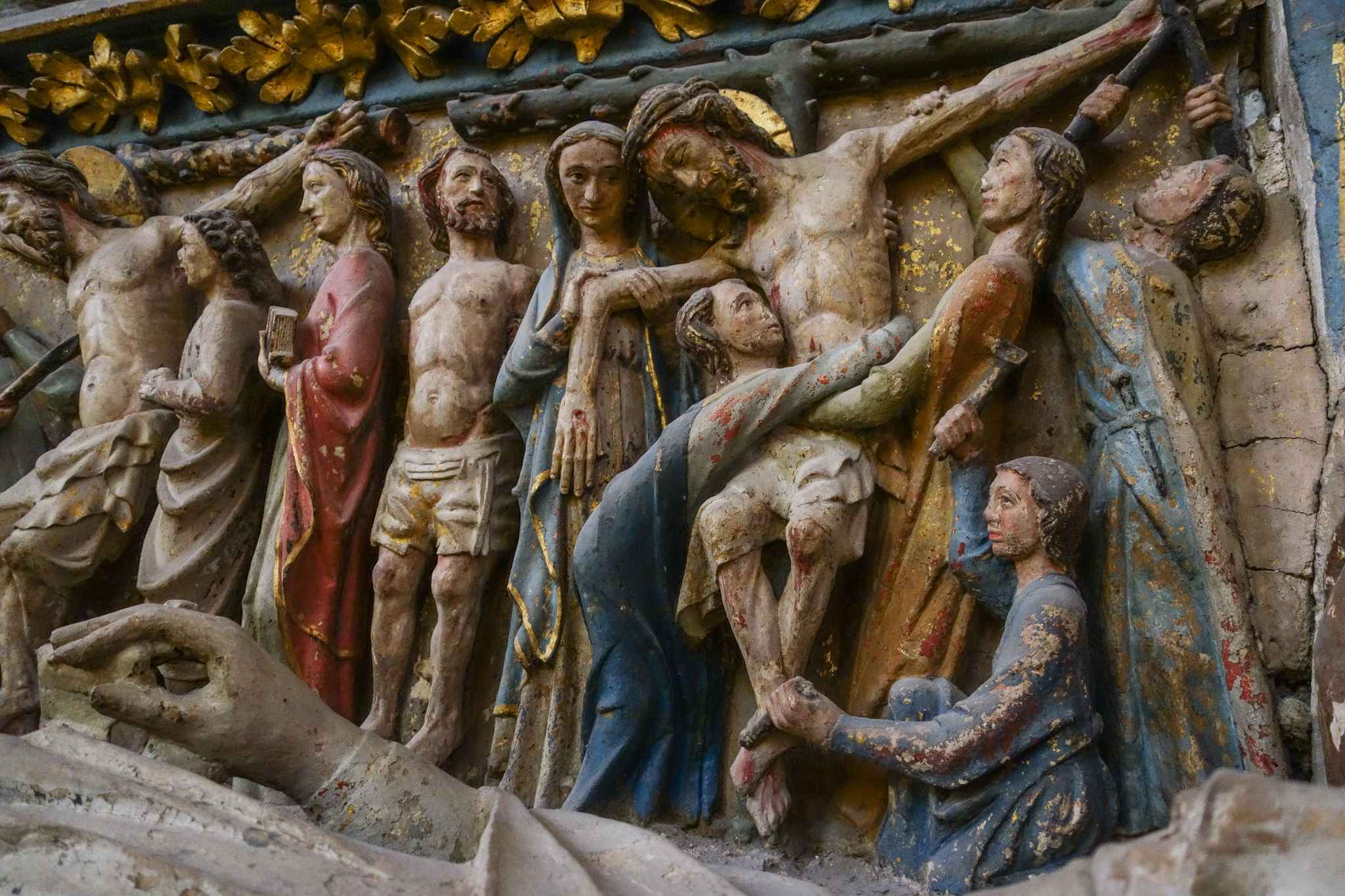
2016-03-24-1458839354-9546830-LeonCrucifixionsm.jpg
Keep your mind in hell, and despair not.
— Staretz Silouan
Ah, children, ah, dear friends, do not be afraid of life!
— Fyodor Dostoevsky
How do we sing the Lord’s song in the shadow of terror? In solidarity with all the victims of Brussels and the whole human family this week, I protest, I rage, I grieve, I pray. But I must also try to think.
Indiscriminate terror has long been a scourge on this earth, but its globalization through television and social media has now made it emotionally inescapable. Were I to dwell in the uttermost parts of the sea, I could not flee from its presence.
So as we try to absorb the terrible news from Brussels, how do we “despair not” even in the face of monstrous evil? No simple task, and easy answers seem disrespectful in the time of weeping. But I do believe the antidote to despair is to keep the faith. We must never forget the sacred story we belong to. Even at the grave we make our song: Alleluia, alleluia, alleluia.
The terrorist, on the other hand, belongs to a story which for most of us in inconceivable. Don DeLillo calls terror “the language of being noticed,” a kind of performative rhetoric designed to bring a neglected or disregarded worldview into the open by subjecting others to the violent norms of its alternate reality. Terrorists see themselves as global victims, in search of a global audience for their cruel narrative. Mark Juergensmeyer, in Terror in the Mind of God: The Global Rise of Religious Violence, explains this terrorist rationale:
If the world is perceived as peaceful, violent acts appear as terrorism. If the world is thought to be at war, violent acts may be regarded as legitimate. They may be seen as preemptive strikes, as defensive tactics in an ongoing battle, or as symbols indicating to the world that it is indeed in a state of grave and ultimate conflict. (10)
In the minds of many terrorists, the war they are so eager to wage is apocalyptic, a cosmic conflict of good and evil in which there is no compromise or bridging of differences. They are, in DeLillo’s term, “lethal believers.” And the very worst thing we could do in response would be to play the part they have written for us: satanic enemies in a cosmic struggle. The proposals of certain American presidential candidates to “bomb the hell out of them,” or bring back the good old days of torture, would play perfectly into the terrorists’ hands, conceding the primacy of their deadly story.
However, I choose to belong to a better story, the one enacted and embodied in the powerful liturgies of Christ’s Passion. Step by step on the Way of the Cross during Holy Week, Christians will bring to mind and heart the saving journey which Jesus made, without weapons, into the abyss of suffering and death.
Renouncing all violence and hatred, Jesus remained faithful to the end. After pouring his whole life into a ministry of healing, forgiveness, and reconciliation, he continued to show us the face of love even as he was tortured on the cross. “Father, forgive,” he said with his dying breath. To the last moment, in his most bitter hour, he remained the human who shows us God by doing what God does.
Which story do we choose to live in? The story of terror and violence, or the story of self-diffusive love? Both are costly in the end, but only one leads to new and unconquerable life. Even after Brussels, the word remains: Be not afraid! Love makes the abyss into a Way. In the words of a 12th century hymn, “the gates of death are broken through / the strength of hell is tamed.”
When medieval women mystics contemplated the cross in prayer and vision, they saw not death’s triumph but a kind of birth. The crucified Jesus was like a woman in labor, enduring pain and travail in order to bring us all to birth. As Marguerite d’Oingt wrote in the 14th century:
Ah! Sweet Lord Jesus Christ, who ever saw a mother suffer such a birth! For when the hour of your delivery came you were placed on the hard bed of the cross and ... in one day you gave birth to the whole world.
To see such a death and call it birth is the central act of Christian imagination. It is why we declare God’s victory at the cross. We don’t wait for Easter Sunday. We declare victory on Good Friday because the Passion isn’t just a story about violent powers that always trample the weak and kill the prophets. It’s also a story about the Realm of God, where dry bones breathe and lost hopes dance, where the prodigal is welcomed home and the tears are wiped from every eye. The Love that makes such a realm was nailed to a cross, but was not consumed by it. Death did what death does, and God did what God does.
And on the outcome of that story, I stake everything.


Monday, April 4, 2016

A Sermon on Hope Amid Our Fearful State of Race and Politics


But Joy Comes in the Morning: A Sermon on Hope Amid Our Fearful State of Race and Politics

03/18/2016 10:00 am ET | Updated Mar 19, 2016


Jim Wallis Christian leader for social change; President and Founder @Sojourners

Politics will not be enough to confront this 2016 election. We will also need a spiritual message. There are gospel issues at stake here, particularly on the issues of race, with America’s original sin now being sold as a political strategy to angry white people. Racism is being incited and condoned, and now violence is being incited and condoned. So we will need to bring what Archbishop Desmond Tutu once called “a spirituality of transformation.” I remember when he preached that message from the pulpit of the National Cathedral in Washington, D.C. I had the blessing of preaching from that same pulpit this past Sunday, and I wanted to share the sermon I preached with you. Polls won’t be enough anymore for this election. We are going to need sermons. Here’s one.

What does the Word of God mean in our lives and our times? That is always the question for us as the people of God. How does the narrative of the Word of God change our narrative?
My wife, Joy Carroll was one of the first women ordained in the Church of England — she is a Brit! And in the U.K., she is well known as the Real Vicar of Dibley (after the hit television show in which she was the script consultant).
One summer we went to the Greenbelt Festival, where we had first met, with our 4-year-old son, Luke. Joy was up on the stage celebrating the Eucharist for 25,000 British young people. My young son, sitting on my lap, was watching his mom lead the service. She would speak and people would respond, “The Lord be with you ... and also with you. She would ask them to do things and they would. After watching this for a while, Luke looked up at me and asked. “Dad, can men do that too?” Women in ministry are changing the narrative in the church, the society, and in our families.
I’m sure many of us here today are finding the narrative in our country very troubling.
What does the Word mean? How does it ‘touch down,’ ‘hit the streets’ in the face of what we are now seeing in the world — in the angry racial rhetoric of a presidential election campaign, and even in the violence at political rallies this very week?
And as a Christian, my doctrine of the incarnation is that in Jesus, God hits the streets. What does that mean for the church right now — for the body of Christ — to help lead by also for getting its own house in order?
What is behind all the angry talk, alarming conflict — and where are we going? Can and how will the people of God help make a way, a path in the sea, and find sustaining streams in the desert?
I was reflecting on Isaiah 43:16-21 in light of what we are seeing and many of us are feeling in our country right now.
16 Thus says the Lord,
who makes a way in the sea,
a path in the mighty waters,
18 Do not remember the former things,
or consider the things of old.
19 I am about to do a new thing;
now it springs forth, do you not perceive it?
I will make a way in the wilderness
and rivers in the desert.
WATCH the sermon:
I believe the great political and historical reality behind all the rhetoric and conflict we now see and feel in our country is this: In just a few decades, America will no longer be a white majority nation; we will instead be a majority of minorities. And some of our citizens, especially many older white Americans, are having deep fears and resentments about that — the potential loss of the historic white supremacy and privilege, which all of us have become accustomed to and which, I believe, was America’s original sin.
That sin must now be clearly relegated to the “former things” and dramatically put away as the “things of old,” as Isaiah says. Our original sin was at the very foundation of our country — the decision to justify our slavery by claiming that black lives matter much less than white lives. Because the sin is so deep in our American DNA, it won’t be overcome easily. The lame claims of “I am not a racist,” fall mute in the face of parables like Flint, Mich., which are teaching us that racism is literally in the air we breathe and the water we drink.
For Christians, and both Jews and Muslims, repentance doesn’t just mean saying that you are sorry, it means turning and moving in a new direction. And some good news (yes, there is some) is that we are beginning to see both blacks and whites, along with members of other racial communities — especially a new generation — asking in new and fresh ways how we can turn around so that black lives do matter, so that all lives finally can — and that the first is necessary for the last.
Many working class white people in America are angry for understandable economic reasons: losing incomes, jobs, homes, families, children in war, and the attention of the both Wall Street and Washington. But such anger is now in great danger of being manipulated and used for self-aggrandizing political purposes — to aggressively divide rather than to crucially unite America.
So what’s happening in our nation now, even in the last several days, is both frightening and dangerous. As the people of God, we need to ask ourselves how we will help heal our country.
Our text from Isaiah says God can help us inspire that mission:
... for I give water in the wilderness,
rivers in the desert,
to give drink to my chosen people,
21 the people whom I formed for myself
so that they might declare my praise.
The good news is that I see that new conversation — with a commitment to action — taking place around the country.
I have just come home from a book tour of “town meetings” in 15 cities across the country where there was a real hunger for multiracial truth-telling, fighting for justice, and praying for healing. These meetings were large, multiracial and multicultural, women and men, and very intergenerational. Seeing so many young people coming and trusting the environment enough to speak their hearts and minds was especially exciting to me. The meetings were also interfaith, and included people with no religious faith at all, but with strong moral commitments to racial, economic, and criminal justice.
Over the last few years, the public revelations of so many tragic killings of young men and women of color, and the rise of a new generation of activists, are awakening many. I even hear more and more white Christians agreeing with us when we say that if we acted more Christian than white, black parents might have less fear for their children. It’s sparking deep conversions about “whiteness” as an idol and not just an ideology.
But amid all of this while we were experiencing these powerful, very diverse, and hopeful town meetings — from the East Coast to the Midwest, to the West Coast, and even in the South — the media kept only focusing on the state of the political horse race.
While what I saw Americans discussing was the more difficult but much deeper discussion of the state of race in America — underneath the narrow media and political discussions which still mostly leave “race” out of our public discourse. But beneath that narrow mainstream focus on polls and politics, the deeper conversation is now occurring, which is just what our nation most needs right now.
Perhaps now, with the escalating racial rhetoric and violence of the presidential campaign, the media can bring the crucial issues of race, division, and unity to the center of our public discussion. I hope and pray so.
Over the past few months, I have seen black, Hispanic, Asian, indigenous, and white voices together embracing America’s growing diversity and asking how we can build that bridge to a new America. And that’s a discussion I almost never hear about in the mainstream media — right to left.
However, this cannot just be a political movement and neither political party has yet to adequately embrace the requirements of racial justice and healing. It will be only a spiritual movement that can help change politics. As Desmond Tutu often reminded us, and did so from this very pulpit, we need the “spirituality of transformation.” That is indeed what we now most need for a new American future. And as Pope Francis has clearly and recently told us, building bridges rather than walls is the Christian vocation.
On the tour, we visited cities that have also become “parables,” stories from which we can learn important lessons about America, like Ferguson, Baltimore, Chicago, Minneapolis, and Atlanta. We went to very diverse cities, like Los Angeles and New York, to still very white cities, like in the Pacific Northwest. But everywhere we found people who believe that the emerging American diversity is a gift and a blessing — and not a danger and a threat! Can I get an Amen to that?
But that will take a battle, a moral battle, a struggle for the integrity of our faith — and one that people of faith and moral values will have to make.
Throughout my travels, one of our Christian Scriptures came up again and again: Galatians 3:28.
“There is neither Jew nor Gentile, there is neither slave nor free, there is neither male nor female; for you are all one in Christ Jesus.”
Given what is happening on our country now, it is time to shout out that text!
This Galatians text was a baptismal text and liturgical formula in the early church. Baptism is where new converts made their faith public and the new Christian community was clearly saying this: The three oppressive things that divide humanity are these Galatians factors — race, class, and gender. All three separate us form one another. At their baptisms the new church was making this very public — that what they were about as the community of following after Jesus, the body of Christ — was to undermine, overcome, and take down those barriers, and begin to create a new and united community. They were, in effect, saying if you don’t want to be a part of that — a community bringing down the divisive forces of race, class, and gender — you don’t want to come here because that is what we are about! Unity, instead of division, is part of our vocation as ministers of Christ’s gospel of reconciliation.
Imagine if that was the primary message to a divided America right now — from those who name the name of Jesus. So let us get that message out — even now in the face of this alarming and dangerous racial rhetoric, which included fear and hatred, and even violence, which racism has done since the beginning of America.
Rev. Dr. Martin Luther King Jr. famously said 50 years ago that the most segregated hour in America is 11 a.m., the hour we are together today! But I have been in churches where a new generation is transforming themselves into multicultural communities, and one I preached in had an average age of 28.
Here’s a local story from the John Eaton Elementary School, just blocks from here and where the kids see this Cathedral every day. All my kids went there as the most diverse elementary school in Washington, D.C. When I spoke to my son Jack’s 5th grade class about immigration, which they were studying, I told them about the 11 million immigrants who, because they are undocumented, can’t get the medical care or police protection they need, and how their families were being separated and destroyed by 1,000 deportations per day. The kids were immediately and deeply concerned, and asked me, “Why doesn’t Congress fix that? Have you talked to them? What do they say?”
I told them I had talked to them, and they told me their constituents were afraid. “Afraid of what?” the students asked. I looked at their class, all the worried faces staring at me, and then it hit me. There they were, a Washington, D.C., 5th grade public school class — African American, Hispanic, Asian American, Native American, white, Somali, Maltese, and other international students — “They’re afraid of you,” I said. The kids were astonished. “Afraid of us? Why?” I told them, “Because you look like what America is becoming ... You’re the new America.”
Now perplexed, the students said, “But why are they afraid of that?”
A very good question. “Because they don’t think it’s going to work,” I told them. “Tell me, is it working?”
The kids looked at each other, then at me and several said, “Yeah ... it’s working great! It’s really cool.”
I told them our job was to show America that this new more multiracial and multicultural nation really will work, will make us even better and yes, “is really cool.”
Now that is also the job of the faith community, central to our vocation: to show that this will really work, that this was God’s design and dream from the beginning of creation described in Genesis. Instead of our becoming an illusory post-racial society, the book of Revelation ends with the worship of God by countless numbers of people — in their own diverse languages, tribes, and ethnicities. Our job right now in this country is not only to call out the racism we see, but also to lead by example — by getting our own houses of worship in order and using the power of our multiracial relationships to change public spaces and public policy.
We have to change the narrative of race in America, where privilege and punishment are the outcomes of skin color — that just cannot be accepted by people of faith.
My wife Joy has helped change the narrative for her children and many others about what women can or cannot do. What would it mean for the people of God in America to change our nation’s narrative on race, to repent of our original sin of the racist valuing of other lives less, to help to build a bridge over our present turbulent waters, and find a path though our current political wilderness — all to an emerging new America? I believe our nation is waiting for that.
This Psalm has a pastoral word to those who suffer such pain and anguish from our original sin of racism but still press on toward the goal of justice, equality, and unity.
5 May those who sow in tears
reap with shouts of joy.
6 Those who go out weeping,
bearing the seed for sowing,
shall come home with shouts of joy,
carrying their sheaves.
Amen.
Jim Wallis is president of Sojourners. His book, America’s Original Sin: Racism, White Privilege, and the Bridge to a New America, is available now.

Saturday, April 2, 2016

Jewish Tartan


This Is The World’s First Official ‘Jewish Tartan’

The design, created by a Scottish rabbi, celebrates both Scotland’s history and Jewish values.

In case you missed it: The world’s first official “Jewish tartan” is really a thing. Yes, it’s kosher and yes, you can buy it online in many forms, including as a prayer shawl, a skull cap and — of course — a kilt.
Created by Mendel Jacobs and officially registered with the Scottish Tartans Authority, the tartan boasts a distinctive pattern of blue, white, red and gold.
“I chose blue and white as the colors of both the Israeli and Scottish flags,” Jacobs, who is said to be Scotland’s only local-born rabbi, told the Scotsman. “The central gold line represents the gold from the Ark in the Biblical Tabernacle and the many ceremonial vessels. The silver is to represent the silver that adorns the Scroll of the Law and the color red is for the traditional red Kiddush wine.”
According to the International Business Times, the tartan is creating buzz on social media this week. It’s made from a kosher cloth that abides by shatnez, the Jewish law that forbids the mixture of wool and linen in clothing.
“For over 300 years, Scots Jews have waited for their own tartan and now here it is,” Jacobs said, according to IBT. “The Jewish people have been an integral part of Scottish culture for more than 300 years, with the first Jew recorded in Edinburgh in 1691. In Scotland, the Jews were never persecuted and there were no pogroms, no Holocaust, no national or state sponsored anti-Semitic laws. When England was burning and exiling its Jews in the Middle Ages, Scotland provided a safe haven from English and European anti-Semitism.”
The Jewish tartan actually dates back to 2008, when a Glasgow dentist and a Jewish newspaper editor first came up with the idea for a “kosher” version of the iconic pattern. 
“We’ve already had a lot of interest from around the world,” Jacobs told the Scotsman. “It’s nice to produce a symbol that represents both Jewish and Scottish culture.”
The Scottish Tartans Authority said that other people have expressed interest in designing their own Jewish tartan, but the group insisted there can only be one official design on the books.
“We only have one Jewish Tartan on the register and it’s certainly a case of first come, first served. We couldn’t register two tartans with exactly the same name,” a spokesman said.

Army Rules Sikh Officer Can Keep His Turban

Army Rules Sikh Officer Can Keep His Turban, Beard On Active Duty

A huge step in the right direction.

A Sikh army captain who sued the U.S. military for discrimination in March has won the right to continue serving on active duty while upholding his religiously mandated turban and beard.
The U.S. Army released its decision on Thursday to grant Captain Simratpal Singh “religious accommodation” to the rules against facial hair and headwear, adding that “the Army intends to gather information to develop uniform standards for religious accommodations.”
“My military service continues to fulfill a lifelong dream,” Singh, a West Point graduate who earned a Bronze Star in Afghanistan, said in a press release. “My faith, like many of the soldiers I work with, is an integral part of who I am. I am thankful that I no longer have to make the choice between faith and service to our nation.”
Courtesy of the Sikh Coalition After years of cutting his hair and shaving his face, Captain Simratpal Singh will no longer have to choose between his faith and his calling.
After years of cutting his hair and shaving his face, Singh was finally granted a temporary accommodation in December. Assistant Army Secretary Debra Wada ordered tests in March to determine whether Singh could safely wear a helmet and gas mask if he had a turban, uncut hair and a beard.
Thursday’s decision by the Army states that Singh will not have to reapply for accommodation in the future.
“In a political context where minorities are being marginalized and attacked routinely, it is critical that our nation’s largest institutions and employers — like the U.S. military — show the country that America embraces diversity,” Simran Jeet Singh, the Senior Religion Fellow for the Sikh Coalition, told The Huffington Post.
He added, though, that this decision is just one step toward ending the discriminatory policies regarding article of faith for service members.
In 2014, the U.S. military began taking steps to give individual troops greater freedom to wear turbans, head scarfs, yarmulkes and other religious clothing with their uniforms. A spokesman for the Sikh Coalition noted at the time that the religious accommodation would have to be approved each time a service member changed assignments and would default to the discretion of their commanders.
Just two day’s before the Army released its decision on Singh’s case, three other Sikh soldiers filed a lawsuit seeking similar accommodations from the Army. With Singh’s victory and the Army’s promise to “develop uniform standards,” there may be hope for others in a similar predicament.
 

Friday, April 1, 2016

The Way Forward


The Way Forward
April 10, 2016
Written by Kathryn Matthews
Sunday, April 10
Third Sunday of Easter
Focus Theme
The Way Forward
Weekly Prayer
God of victory over death, your Son revealed himself again and again, and convinced his followers of his glorious resurrection. Grant that we may know his risen presence,
in love obediently feed his sheep, and care for the lambs of his flock, until we join the hosts of heaven in worshipping you and praising him who is worthy of blessing and honor, glory and power, for ever and ever. Amen.

Focus Scripture
Acts 9:1-6, (7-20)
Meanwhile Saul, still breathing threats and murder against the disciples of the Lord, went to the high priest and asked him for letters to the synagogues at Damascus, so that if he found any who belonged to the Way, men or women, he might bring them bound to Jerusalem. Now as he was going along and approaching Damascus, suddenly a light from heaven flashed around him. He fell to the ground and heard a voice saying to him, "Saul, Saul, why do you persecute me?" He asked, "Who are you, Lord?" The reply came, "I am Jesus, whom you are persecuting. But get up and enter the city, and you will be told what you are to do."
[The men who were traveling with him stood speechless because they heard the voice but saw no one. Saul got up from the ground, and though his eyes were open, he could see nothing; so they led him by the hand and brought him into Damascus. For three days he was without sight, and neither ate nor drank.
Now there was a disciple in Damascus named Ananias. The Lord said to him in a vision, "Ananias." He answered, "Here I am, Lord." The Lord said to him, "Get up and go to the street called Straight, and at the house of Judas look for a man of Tarsus named Saul. At this moment he is praying, and he has seen in a vision a man named Ananias come in and lay his hands on him so that he might regain his sight." But Ananias answered, "Lord, I have heard from many about this man, how much evil he has done to your saints in Jerusalem; and here he has authority from the chief priests to bind all who invoke your name." But the Lord said to him, "Go, for he is an instrument whom I have chosen to bring my name before Gentiles and kings and before the people of Israel; I myself will show him how much he must suffer for the sake of my name." So Ananias went and entered the house. He laid his hands on Saul and said, "Brother Saul, the Lord Jesus, who appeared to you on your way here, has sent me so that you may regain your sight and be filled with the Holy Spirit." And immediately something like scales fell from his eyes, and his sight was restored. Then he got up and was baptized, and after taking some food, he regained his strength. For several days he was with the disciples in Damascus, and immediately he began to proclaim Jesus in the synagogues, saying, "He is the Son of God."]
All Readings For This Sunday
Acts 9:1-6, (7-20)
Psalm 30
Revelation 5:11-14
John 21:1-19
Focus Questions
1. How does Saul resemble Christians you know today, before and after his conversion experience?
2. Why do we need the church once we sense we have been called?

3. Why do you think violence and religion are so often linked?
4. Does your church focus on converting individuals, or building up the church? What's the difference?
5. What sort of "cultural bias" blinds us today, and keeps us from welcoming and including others into the circle of God's grace?
Reflection by Kate Matthews
Most of us know the story of Saul, persecutor of the early church, who was knocked to the ground, blinded by a bright light, and addressed by the risen Christ Himself. (According to later Christian artists, he was thrown from his horse; John Dominic Crossan and Jonathan Reed's book, In Search of Paul, provides a delightful interpretation of this addition to the story.) Was that a call from God, or was it a conversion experience? The scholars may disagree, but in any case, most of us "ordinary" Christians go through our lives without ever being literally knocked off our horses and blinded by a light, in our conversion or our call experiences. We mostly go from day to day, year to year, sometimes searching, sometimes convinced, but rarely experiencing dramatic revelations that change the course of our lives, let alone the life of the whole church, as the experience of Saul did. And yet we can find ourselves here, in the story of Saul's transformation from persecutor to apostle.
The part of Saul's story in this week's passage is a reversal of sorts, but his new direction can be seen as consistent with his past as a religious scholar and a faithful son of Israel. Later in the Book of Acts, he boasts of being a Pharisee; he does not repudiate his past, who he is or who he has been. Rather, his vision is opened up to new understandings and new relationship (and new work!). In fact, Marcus Borg and John Dominic Crossan describe his conversion as within his own tradition, "from being a Pharisaic Jew to being a Christian Jew" who "saw his Judaism anew in the light of Jesus."
The influence of our teachers
In Acts 22:3, Paul also describes himself as a student of Gamaliel, whom we met last week during the controversy in the council in Jerusalem over what to do with these troublemakers, Peter and the rest, who are preaching Christ Jesus. Gamaliel could be seen in that passage as a voice of tolerance and humility, so it's intriguing to consider how his influence on Saul might have helped to shape who he became as Paul, the Apostle to the Gentiles, and to prepare him for his important ministry.
We've met Saul before this ninth chapter in the book of the Acts of the Apostles, of course, but only briefly, and not in a good way. At the end of chapter seven, the men who were stoning Stephen (after he delivered a particularly confrontational sermon) "laid their coats at the feet of a young man named Saul" (7:58), and chapter eight begins by noting Saul's approval of the killing of Stephen. As resistance and even persecution of Jesus' followers heated up, Saul participated enthusiastically: "ravaging the church by entering house after house; dragging off both men and women, he committed them to prison" (8:3). Luke spends the rest of chapter eight telling stories about the apostles as they preached and baptized and laid hands on people, as they drove out demons and cured "those who were paralyzed or lame"; no wonder "there was great joy in that city" (8:8).
"Breathing threats and murder"
All of this joy, however, and all of this success, evidently worked Saul up into a frenzy, for chapter nine opens with him "breathing threats and murder" (9:1). What a phrase to describe a future follower of Jesus! Saul obtained authorization from the leaders in Jerusalem to hunt down the followers of the Way as they spread their message up the road to Damascus, to "bind" them, and drag them back to Jerusalem. John Dominic Crossan and Jonathan L. Reed describe this kind of "zeal" as "religious vigilantism" that "allows any outraged person" to take justice and, well, righteousness, too, it seems, into their own hands. I wonder if the same kind of zeal has contributed to the vitriol of our present political season; judging "religious fanatics" long ago and far away is not nearly as helpful as thinking about our own way of living what we believe.
So we can assume that Saul intended that the apostles would suffer the same fate as Stephen, and we grieve that this story about religious people--filled with "zeal as violence," as Crossan and Reed describe it, and yet seeing that as faithfulness--is true in every age. It's there, on the road to Damascus, that Saul's story takes a dramatic turn, and even today people refer to an experience of conversion, or call, or illumination, as a "road to Damascus" experience.
What happens next...
The lectionary passage may technically end at verse six, but commentators make a convincing case to stay with Saul on his journey. The lectionary seems to leave us hanging there, wondering what will happen next to Saul, because most of us know that he's now blind, as well as lying there in the dust and dirt of the road. He's pitiful, really, transformed from the threatening, powerful persecutor to a man in profound need and helplessness. God is at work here, though: the living Christ is not simply intervening to protect the apostles by deterring Saul from his mission. The voice that Saul hears gives him instructions right after that poignant question, "Saul, Saul, why do you persecute me?" (v. 4b), and we continue past verse 6 to hear what happens next, because we know that God has big plans for Paul and for this fledgling church. With God, the picture is always big, very big, and each one of us is precious within it.
Led by the hand toward reconciliation
Ironically, Paul finds himself--the strong young man who had felt powerful to the point of menacing--meekly led by the hand into the city of Damascus, and going without food or water for three days; he must have been quite weak, and quite a sight, by then. How much of a threat could he have posed to the disciples at that point? And yet, when Ananias, one of the disciples in Damascus, had his own experience with a vision and voice, he did not react positively to the command to go to Saul and lay hands on him. We can understand why Ananias, knowing Paul's track record, might say, "Wait. What?" He might even want to whine a bit about the unfairness, and the risk, of what he's being asked to do. As Donald Davis notes, "In case God has overlooked Saul's atrocities, [Ananias] takes occasion to issue a brief reminder. Ananias is not the last believer who has seen fit to keep God up to date."
But then Ananias surprises us, once he answers God's call, and goes the extra nine yards, calling Saul "Brother." Did his heart soften, perhaps, when he saw how weak and pitiful Saul looked? Perhaps such mercy helped shape Paul's future ministry and theology. And here we might find ourselves in the story as well, because Charles Campbell says that Ananias is "an 'ordinary' Christian" who demonstrates "extraordinary courage and faithfulness," the kind of courage and faithfulness we ordinary Christians may need in order to forgive and to exercise compassion toward our "enemies" and those who have harmed us. Robert Wall also emphasizes the power of forgiveness in this story, noting that we first met Saul at the stoning of Stephen, who prayed (like Jesus) that those who killed him would be forgiven: "God's steady perspective on human destiny is that Saul is a forgiven man….[and] his stunning turn to Jesus somewhere on the Great North Road cashes in a faithful Stephen's promissory note." A lovely, and ironic, twist to the story.
The way forward
Where did Saul go with all of this? He followed the way forward to get baptized, and to share communion, and to be "ordained," and to live his life in the company of others who followed the Way of Jesus. Borg and Crossan speak of Paul being filled with the light of Jesus and the Spirit that opened his eyes and gave him "a new identity…a new community, and way of being." And this new community would include--with Paul's tireless efforts--the most unlikely people.
Perhaps the most dramatic sign of Saul's conversion was his passionate commitment to sharing the gospel with the Gentiles. Crossan and Reed observe that Saul's conversion isn't from one religion to another. He has a different kind of change of heart and mind, converting from passionately, even violently, opposing the radical inclusion of pagans to becoming instead the greatest proponent of including them--how ironic! Scholars remark on the importance of that big picture, of the wider community, and not just Saul's private experience: Charles Campbell observes that Paul devoted the rest of his life to establishing and nurturing churches rather than focusing on the conversion of individual people. In a time when many Christians focus on evangelizing individuals instead of building up churches, this is a provocative comment, and may offer a needed course correction.
Sometimes a call is a conversion
A call is a call, and a conversion is a conversion, but often they are combined in the same experience. Whether or not our faith experiences are typically accompanied by a dramatic sound-and-light show, we receive the same call that Saul did on that dusty road to Damascus. After looking honestly at our past and repenting our sin, we are called, Paul Walaskay writes, "to turn our faces toward God's future….[and] enter the process of completing God's joy by expanding God's love in the world." Luke's version of Paul's experience on that road to Damascus (the first of three accounts of it in Acts) vividly illustrates how God finds a way to reach us, even if we have to be stopped in our tracks and knocked off our own high horse. It's not so hard, then, to believe that God will find ways to enter quietly into our lives and our hearts, turning our attention away from old angers, prejudices, and loss, old convictions and conclusions written on the stone of our hearts and minds, and will open our hearts to God's way of seeing things, open our hearts to God's future of hope, a bright shining light.
If we feel that such a quiet experience isn't as good or significant or valid as those we read about in books--the Bible and others as well, Joseph Harvard urges us not to give in to a sense of "faith inferiority," because conversion is about what God is doing, not our own accomplishments or strengths. In so many conversion stories, including the ones found in Acts, like those surrounding the story of Saul, God will transform the lives of the most unexpected, unlikely people and use them in God's work. That includes you and me, and some folks we'd rather not think about, if we're honest. Surely God can't use them, we might think, but God surprises us in the most delightful ways. If we need any proof of that we might take Stephen Jones' advice and reflect on our own lives, to look back on the times when God did something amazing and turned us around just as surely as God turned Saul around on that road to Damascus.
God's grace is amazing
We might remember, then, another historical call/conversion story familiar to many of us, that of John Newton, the slave-trader who later became a pastor and hymn writer. Newton is famous, of course, for composing "Amazing Grace," but most of us have at least a vague recollection of a dramatic conversion at sea, after which Newton stopped participating in the great evil of the slave trade. We might think that Newton, like Paul, had an experience very unlike our own, a sudden, drastic turnaround in the most remarkable of circumstances. But closer study reveals that Newton took his time with this turnaround, and continued his slave-trading even after it dawned on him that God was at the center of his life. We live our lives in circumstances that may be dramatic at moments but are mostly everyday and common, and God's amazing grace is present and sufficient in every one. And even if it takes us some time, God is with us all the way, in every moment of our lives.
A preaching version of this commentary (with book titles) is at http://www.ucc.org/worship_samuel.
The Rev. Kathryn Matthews serves as dean of Amistad Chapel at the national offices of the United Church of Christ in Cleveland, Ohio (https://www.facebook.com/AmistadChapel).
You're invited to share your reflections on this text in the comments on our Facebook page: https://www.facebook.com/SermonSeeds.
For further reflection
Plato, 5th century B.C.E.
"Conversion is not implanting eyes, for they exist already; but giving them a right direction, which they have not."
Madeleine L'Engle, 20th century
"Conversion for me was not a Damascus Road experience. I slowly moved into an intellectual acceptance of what my intuition had always known."
D.H. Lawrence, 20th century
"I believe that [one] is converted when first [one] hears the low, vast murmur of life, of human life, troubling [one's] hitherto unconscious self."
George Sand, 19th century
"Once my heart was captured, reason was shown the door, deliberately and with a sort of frantic joy. I accepted everything, I believed everything, without struggle, without suffering, without regret, without false shame. How can one blush for what one adores?"
C.S. Lewis, Mere Christianity, 20th century
"The world does not consist of 100 percent Christians and 100 percent non-Christians. There are people (a great many of them) who are slowly ceasing to be Christians but who still call themselves by that name: some of them are clergymen. There are other people who are slowly becoming Christians though they do not yet call themselves so."
and
"Every story of conversion is a story of blessed defeat."

Donald Miller, Blue Like Jazz: Nonreligious Thoughts on Christian Spirituality, 21st century
"When one of my friends becomes a Christian, which happens about every 10 years because I am a sheep about sharing my faith, the experience is euphoric. I see in their eyes the trueness of the story."
Bede Griffiths, 20th century
"It is no longer a question of a Christian going about to convert others to the faith, but of each one being ready to listen to the other and so to grow together in mutual understanding."
Saturday, March 26, 2016

Easter: A Celebration Of The Resurrection Of Jesus Christ


Easter: A Celebration Of The Resurrection Of Jesus Christ

Easter is one of the most important holidays in the Christian calendar.

03/25/2016 02:08 pm ET
  • HuffPost Religion Editors The Huffington Post
Easter Sunday is on March 27 and the Orthodox Church observes the holiday on May 1.
Easter, also known as Resurrection Sunday, celebrates the resurrection of Jesus Christ. Christians believe that Jesus was crucified on Good Friday, and rose from the dead three days later on Easter Sunday. The day marks the end of Lent, a 40-day period of fasting, prayer and penance, and is followed by a 50-day period called Eastertide, which ends with Pentecost Sunday.
The celebration of the resurrection of Jesus is observed as an Easter Vigil (also known as Paschal Vigil) in Roman Catholic, Eastern Orthodox, Lutheran and some Anglican churches, and “Sunrise Service” in many Protestant churches. Borrowing from the Jewish tradition, a liturgical day begins at sunset, and thus the Easter Vigil begins between sunset on Holy Saturday and sunrise on Easter Sunday.
The Easter Vigil service moves from darkness to light, symbolically re-enacting the Easter story of Jesus rising from the dead. The service begins outside the church where the priest lights and blesses a fire. A Paschal candle, representing the Risen Christ, is lit from that fire. The candle is processed through the church, and the Exsultet, Easter proclamation, is sung.
Passages from the Bible are read and the Eucharist (or Holy Communion) is celebrated. In many churches, this is also a time when new members are baptized into the Church in accordance with ancient tradition.
The “Sunrise Service” is similar, but often held outside early in the morning on Easter Sunday, so that attendants can see the sun rise.
However, not all Christians observe Easter Sunday. Groups like the Quakers and Jehovah’s Witness do not observe Easter, believing the celebration to be unbiblical.
Easter Sunday is preceded by Holy Week, which is the last week of Lent. Holy Week marks important events in Jesus’s life as described in the Gospels — his triumphal entrance to Jerusalem on Palm Sunday, the Last Supper on Maundy Thursday, and his death and crucifixion on Good Friday.
The celebration of Easter extends beyond the Church. Egg decorating, egg hunting and the Easter Bunny are examples of Easter customs that have been adapted by the secular world.

Holi 2016: Hindu Festival Of Colors


Holi 2016: Hindu Festival Of Colors Welcomes Spring

Holi is the day people throw colored powder and liquids at each other in celebration.

03/24/2016 03:05 pm ET
  • HuffPost Religion Editors The Huffington Post

Shailesh Andrade / Reuters
Holi is the Hindu festival of colors, celebrating the onset of spring.
Holi (also known as Dol Jatra, Basantotsav) is the Hindu festival of colors. It is celebrated at the end of the winter season, on the last full moon day of the lunar month Phalguna. In 2016, Holi falls on March 23-24.
Holi is observed with great fanfare by Hindus all over the world, with celebrations beginning on the eve of the festival with bonfires and prayers. On the day of Holi, people throw colored powder and liquids at each other in celebration.
Holi celebrations are particularly riotous in India as social rules are relaxed. Colored water is squirted on passers-by, and people are dunked into muddy water. Many people consume bhang, an intoxicating drink made from the female cannabis plant. Social barriers are broken as people of all ages, genders, castes and wealth gather together and celebrate the festival. In fact, it is said that one can get away with almost any kind of behavior on the day of Holi by saying “bura na mano holi hai,” or, “don’t mind, it is Holi.” In addition to the boisterous nature of the festival, this is a time for family members to get together, give gifts, eat special foods and decorate their homes. Overall, this is one of the most spirited and beloved festivals of the Hindu calendar.
The celebration of Holi is recounted in Hindu sacred texts and stories that have passed from generation to generation. Holi commemorates the miraculous story of Prahlada, a young boy and a devoted follower of the Hindu god Vishnu.
According to Hindu texts, Prahlada was born to Hiranyakashipu, the king of demons. Unable to tolerate Prahlada’s devotion to Lord Vishnu, Hiranyakashipu attempted to kill his son several times by poisoning him and throwing him from the top of a mountain but failed each time. Finally, he ordered his son to sit on a pyre on the lap of his demoness sister, Holika, who was protected from fire burning her. Prahlada accepted his father’s command and survived unharmed from the fire while Holika burned to death.
The burning of Holika gave rise to the tradition of lighting bonfires on Holi eve. Holi also celebrates the immortal love of the divine couple, Radha and Krishna. And Holi immortalizes the story of Kama, the Hindu god of love, his incineration to death by Lord Shiva, restoration and his love and sacrifice for all. These are three of the most popular stories, and as with most Hindu festivals, the stories vary slightly in different parts of India.
Holi 2016